.png)
Can a Foreigner Get a Mortgage in Japan? The Honest Answer
- Hello Akiya

- Jun 2
- 4 min read
This is one of the first questions I get, and it's the right question to ask early, because the answer reshapes what's actually possible for a lot of people. A Japan mortgage for foreigners is not impossible. But the conditions are strict enough, and the akiya math is specific enough, that most foreign buyers of cheap rural houses end up paying cash — not because they can't get a loan in principle, but because a loan for that house rarely makes sense or rarely exists.
Let me separate the two things that usually get tangled together: can a foreigner borrow in Japan at all, and can a foreigner borrow to buy an akiya. Those have very different answers.
Residency is the hinge everything turns on
Japanese banks lend based on stability and ties to the country, and for a foreign buyer the single biggest factor is residency status. I studied for a real estate license in California, so I came at this expecting the US framework — credit score, debt-to-income, down payment. Japan cares about some of that, but it leads with a different question: are you actually rooted here?
In broad strokes, the picture looks like this. A foreigner with permanent residency (永住権, eijūken) is treated by most banks much like a Japanese citizen — the door to a normal mortgage is genuinely open. A foreigner on a long-term work visa with stable income and a few years of tax history in Japan can sometimes borrow, often with a larger down payment and from a narrower set of lenders. And a foreigner living outside Japan with no residency, no local income, and no tax record here faces the hardest road by far. Most domestic Japanese banks simply won't write a mortgage to a non-resident with no ties.
I'm being deliberately general here, because the specifics shift by bank, by branch, and by year, and I'd rather you confirm your own situation with a lender than trust a number I half-remember. The shape of it is what matters: the further you are from being a tax-paying resident, the steeper the climb.
Why residency decides a Japan mortgage for foreigners
Even if you clear the residency hurdle, akiya run into a second wall: the house itself.
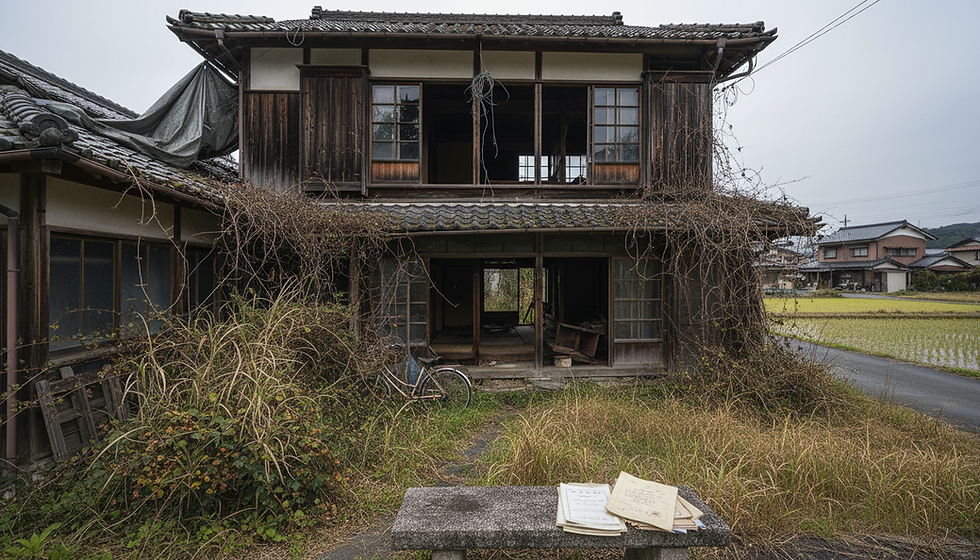
Japanese mortgage lending leans heavily on the building's value, and Japan treats wooden houses as depreciating assets that approach zero value after a few decades. A lot of akiya are old enough that, on paper, the structure is worth essentially nothing — the value is in the land, if there's value at all. Banks are wary of lending against a building they consider functionally worthless, especially in a depopulating rural area where the land won't appreciate either.
Then there's the loan floor. Many lenders won't bother writing a mortgage below a certain amount, and that floor is often higher than the price of the akiya itself. If a house costs ¥3M, you're asking a bank to do a full credit assessment, appraisal, and title check for a loan smaller than what they'd consider worth the paperwork. Most won't.
So you end up with a situation where the cheapness that drew you to the akiya is the same thing that makes it unfinanceable. The houses cheap enough to be exciting are usually too cheap, too old, and too rural to borrow against. That's not a loophole to crack — it's just the structure of the thing.
The financing that actually happens
When akiya purchases do involve borrowing, it tends to look different from a clean mortgage on the property. People bring cash from a home-country sale or savings — by far the most common route, and the simplest. People borrow against assets back home rather than against the Japanese house. People with permanent residency and a renovation budget sometimes finance the renovation through specific products rather than the purchase, since a renovated house has more assessable value than the ruin they started with. And some buyers looking at pricier, more conventional rural homes — not the ¥3M ruins — do get standard mortgages, because those properties clear the value and loan-size hurdles the true bargains can't.
There are a handful of banks known for being more open to foreign and non-resident borrowers than the domestic norm, and they come up often in expat discussions. I'm not going to name rates or terms, because those change and I don't want you planning around a figure that's stale by the time you read this. If financing is central to your plan, that conversation belongs with the lender directly, ideally before you fall for a specific house.
What this means for how you plan
The practical takeaway isn't discouraging; it's clarifying. If you're looking at genuinely cheap rural akiya, build your plan around cash — for the purchase and a renovation budget that will likely dwarf it. If you're hoping to finance, you're really in a different conversation: about residency, about a higher class of property, and about the specific lenders willing to work with your status.
The buyers who get burned are the ones who assume Japanese financing works like home, budget for a small down payment, and discover late that the whole purchase needs to be cash they don't have liquid. Knowing the shape of this early changes which houses you even look at — and that's the most useful thing a clear answer can do.
I don't have a tidy product to sell you on financing, and I'd rather say so than pretend otherwise. This is one where the honest next step is a real lender and, if your situation is complex, a Japanese tax professional. What I can tell you is the lay of the land, and the lay of the land is: cash is the default, residency is the key that opens everything else, and the cheapest houses are the hardest to borrow against.
This is general information, not financial advice — I'm not a lender or a tax professional. Confirm your own situation with a qualified one before you commit to anything.


Comments