.png)
The Real Cost of Buying an Akiya in Japan

Updated: Jun 17
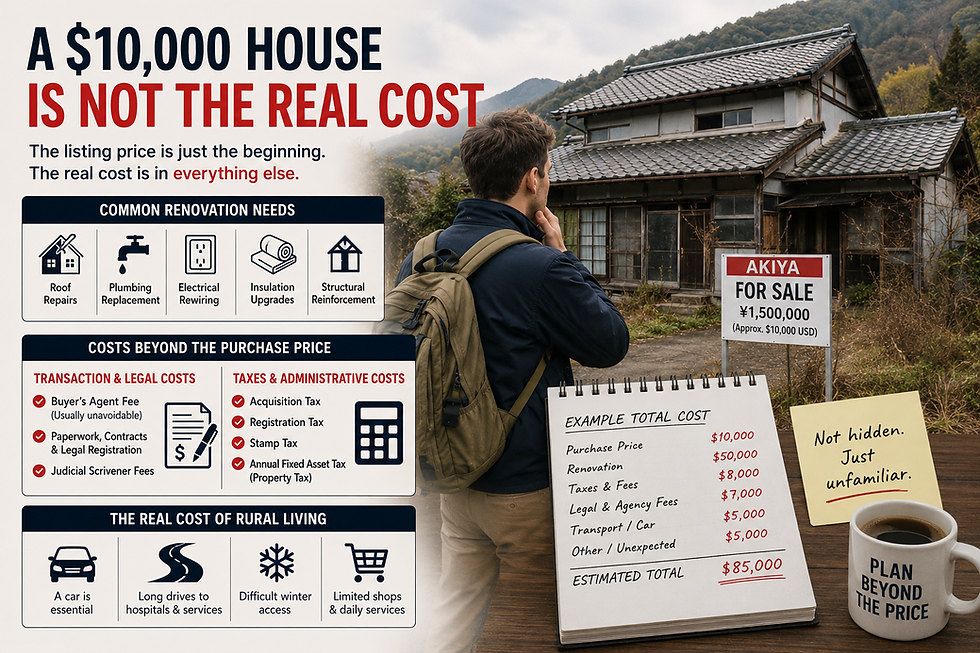
One of the biggest misconceptions about buying an akiya is that the listing price tells the whole story. It doesn't. A ¥1,000,000 house in rural Japan — around $6,500 — can quietly become a far larger project once fees, taxes, and repairs enter the picture.
People searching for cheap houses in Japan often feel like they've found a loophole. Usually what they've found is deferred maintenance. And here's the part worth saying plainly: most of these costs aren't hidden. They're simply unfamiliar to foreign buyers. Once you know what they are, you can budget for them with your eyes open. So let's lay out the real cost of buying an akiya in Japan, line by line.
The price tag is the smallest number
Start with a mental shift: the cheap price isn't the cost, it's the invitation to look closer. The figure that matters is your total project cost — purchase, plus closing costs, plus renovation, plus the ongoing cost of actually living there.
There's a counterintuitive twist with cheap akiya, too. Many of the fixed costs — taxes, agent fees, registration — don't shrink just because the house is cheap. So on a very low-priced akiya, those fixed costs can end up being a larger share of your total spend than the house itself.
So what is the real cost of buying an akiya in Japan?
Break it into the costs at purchase and the costs after. At purchase, several fees are largely unavoidable.
Agent commission. Japanese transactions almost always involve a buyer's-side agent fee, and it's regulated. For properties over ¥4 million, the standard cap is 3% of the price plus ¥60,000, plus 10% consumption tax. But there's an akiya-specific rule worth knowing: since July 2024, for properties priced ¥8 million or under, an agent may instead charge a flat maximum of ¥300,000 plus tax (¥330,000 including tax) — a rule created precisely because low-value vacant homes weren't worth an agent's time otherwise. The practical effect: on a ¥1,000,000 akiya, commission alone can run up to roughly a third of the purchase price.
Taxes and registration. Expect a real estate acquisition tax, a registration (license) tax to record the transfer, stamp duty on the contract, and judicial scrivener (shihō-shoshi) fees to handle the registration. None of these are large individually, but together they add up — and again, they don't scale down for a cheap house.
Even an inexpensive akiya still needs paperwork, contracts, coordination, and legal registration. That's labor, and labor has a price.
Renovation: usually the real budget
This is where the money actually lives. A long-vacant older home commonly needs some combination of roof repair, plumbing replacement, electrical rewiring, insulation, and structural or seismic reinforcement. For a genuine project, renovation often costs more than the purchase price — sometimes far more. (I break the renovation numbers down in a separate post.)
The cheap sticker price, in other words, is frequently just the entry fee for the real work.
The akiya-specific costs people forget
Demolition liability. If the house turns out to be a teardown, you may inherit the cost of removing it — often ¥1–3.5 million.
Clearing the contents. Many inherited akiya come full of the previous family's belongings. Hauling it all away is a real, billable job.
Annual fixed-asset tax. You owe property tax every year you own it, whether or not you're living there.
Ongoing maintenance. A rural house left alone deteriorates fast — especially one you're not occupying full-time.
The cost that isn't the house: rural logistics
Here's the one that catches people most. A countryside house can look peaceful online while quietly demanding a car for everyday life, long drives to the nearest hospital or supermarket, and difficult access in winter. Sometimes the real cost of rural living in Japan isn't the house at all — it's the logistics of living there every single day.
That's not a reason to walk away. It's a reason to picture your ordinary Tuesday in that location before you fall for the photo.
How to budget: think total project cost
Add it all up before you commit: purchase price + closing costs + renovation + clearing + the carrying costs of ownership. Then keep a contingency cushion on top, because old houses surprise you. The buyers who are happy two years later are almost always the ones who budgeted for the whole stack — not just the sticker.


Comments