.png)
What it costs to buy a house in Japan
The price on the listing is not the number you need. On a cheap akiya, the taxes and fees can run a quarter of the purchase price — because most of them are fixed amounts that don't shrink when the house is cheap. Put in a price and see exactly where the money goes.
What each cost is
Real-estate acquisition tax (不動産取得税)
A one-time prefectural tax of roughly 3% of the property's assessed value — not its sale price. It arrives a few months after you take ownership, and it can't be added to a loan. This is the cost foreign buyers forget, because nothing at the closing table mentions it.
Registration & license tax (登録免許税)
Paid when ownership is recorded at the Legal Affairs Bureau — about 1.5% of the assessed land value and 2% of the building. If you buy the property as your own home and it meets the conditions, these rates drop sharply; a second home or investment, or an old building that fails the 1982 earthquake standard, usually doesn't qualify.
Judicial scrivener (司法書士)
The licensed professional who executes the registration. Roughly ¥50,000–150,000. It's a fixed fee, so on a ¥3,000,000 house it's a real slice of the cost; on a ¥30,000,000 house it barely registers.
Stamp duty (印紙税)
A small, tiered tax on the printed sales contract — usually ¥500 to ¥10,000 in this price range.
Agent / brokerage fee (仲介手数料)
Above ¥8,000,000, the legal cap is 3% of the price + ¥60,000 + tax. At or under ¥8,000,000 — the akiya range — a rule introduced in July 2024 lets the agent charge a flat amount up to ¥330,000 instead. That is often more than the percentage would give, which is why a ¥2,000,000 akiya and a ¥7,000,000 akiya can carry the same agent fee.
Consumption tax (消費税)
10%, and it applies to the agent and scrivener fees. It does not apply to the property itself when you buy a used home from a private individual — only new homes from a developer carry it on the building.
Property-tax proration (固定資産税の精算)
Not a tax you owe the government — you reimburse the seller for the part of the year's fixed-asset tax that falls after your closing date.
Why a cheap akiya costs proportionally more
Add up the fixed costs — the scrivener, the stamp duty, the flat agent fee — and they barely move whether the house is ¥1,000,000 or ¥8,000,000. So the cheaper the house, the larger the share you pay on top. The same buyer, the same paperwork, lands near 40% on a ¥1,000,000 house and under 10% on a ¥30,000,000 one. "Cheap" is real, but it's smaller than the sticker suggests. The calculator shows your number; the guide shows how to keep it from growing.
Common questions
How much does it cost to buy a house in Japan?
On top of the price, expect roughly 8–15% for a normally priced home and considerably more for a cheap akiya, where fixed fees dominate. The total covers acquisition tax, registration tax, the agent fee, a scrivener, stamp duty, and a property-tax adjustment. Use the calculator above for a figure tied to your price.
Can a foreigner buy property in Japan?
Yes. There's no nationality or residency requirement to own property or land in Japan, and no special permission needed. Residency affects your financing and your tax filing, not your right to buy.
Why is the agent fee on a cheap akiya so high?
Since July 2024, agents handling low-value properties (¥8,000,000 and under) may charge a flat fee up to ¥330,000 instead of the usual percentage. The work of brokering a ¥1,000,000 house is much the same as a ¥10,000,000 one, so the rule lets agents take it on — but it means the fee is a large share of a cheap purchase.
When does the acquisition tax arrive?
Months after closing — often three to six. It's billed separately by the prefecture, it's based on the assessed value, and it can't be financed. Set the cash aside at purchase so it isn't a surprise.
Do foreigners pay higher fees or taxes?
No. The taxes and capped fees are the same for everyone. What costs foreign buyers extra is paying intermediaries for translation and coordination they could handle themselves — not the government's side of the bill.
Can a foreigner get a mortgage in Japan?
Rarely, and not easily. Most Japanese banks lend only to residents with local income and a long credit history; non-residents are usually buying in cash. Treat a loan as the exception, not the plan.
Why does the calculator use "assessed value" instead of the price?
Japan taxes property on its assessed value (固定資産税評価額), set by the municipality — usually well below the sale price. The calculator estimates that value from your price, so the figure is an estimate. Enter the real assessed value, if you have it from the listing or the seller, for a closer number.
Is this a quote?
No — it's an estimate to plan around, not a bill. Confirm the assessed value and the current rules before you commit money. The full process, document by document, is in The Akiya Guide.
Know the costs.
Now know the steps.
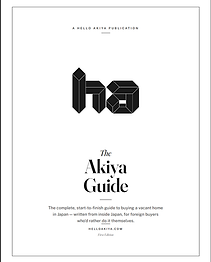
The calculator tells you what an akiya costs to buy. The Akiya Guide tells you how to buy it — reading the listing, the due diligence, the offer, the paperwork, wiring the money, and everything the fees above don't explain. 350+ pages, sourced to the Japanese rules. $199, once.
Not there yet? Start with the free decision tool — whether an akiya makes sense for you, before you spend a yen. →Get this free tool here.