.png)
Can foreigners buy an akiya in Japan?

Updated: Jun 17
Yes. Foreigners can buy an akiya in Japan with the same ownership rights as Japanese citizens — no residency, visa, or citizenship required. The legal part is simple. The harder part is finding the property, reading the Japanese listing, and handling due diligence from overseas, which is where most akiya purchases stall.
Japan places very few legal restrictions on foreign buyers, so the purchase itself is rarely the obstacle. What trips people up is everything around it: the paperwork, the costs that never appear in the listing, communicating in Japanese, and managing a rural property from the other side of the world. This page covers what to actually expect.
Legal basics of property ownership for foreign buyers
Japan's property laws let international buyers purchase real estate with few restrictions. You don't need a visa or residency status to own land or a building.
No citizenship or visa requirement to buy property
Foreigners can own land and buildings outright
No restrictions on the type of property you can buy, akiya included
Owning property does not grant residency or visa rights
Buying a house and moving to Japan are separate processes. You can buy an akiya without living in Japan, but relocating permanently is a separate immigration question with its own rules.
The 2026 rule changes you should know about
Two administrative changes took effect on 1 April 2026. Neither restricts your right to buy — both are about reporting and disclosure.
Nationality disclosure at registration. When you register the ownership transfer at the Legal Affairs Bureau (法務局), you now declare your nationality and submit a passport or residence card copy. This applies to all buyers, Japanese nationals included. Your nationality is stored in the government's internal system, not shown on the public property registry.
FEFTA Form 22 filing. Non-resident buyers must file Form 22 with the Bank of Japan within 20 days of acquisition. The earlier exemption for residential-use purchases has been removed, so this now applies regardless of whether the property is a home, rental, or investment. A judicial scrivener or agent can file it for you, which is the standard route.
Think more paperwork, not more refusals. Foreign ownership remains fully legal with no approval process.
Where akiya are actually listed
Many people assume the municipal akiya banks (空き家バンク) are where you find these houses. They're not the main source. Most listings sit on the large Japanese property portals — SUUMO and at-home — alongside individual agency sites. The akiya banks carry a thinner, more uneven selection and often route you back to a local agent anyway.
Two things follow from this. First, the listings are in Japanese, so you'll be translating descriptions, floor plans, and the agent's notes. Second, the detail that matters most for an akiya — its condition, its history, why it's been empty — is usually not in the listing at all. You have to ask.
What a low price can hide
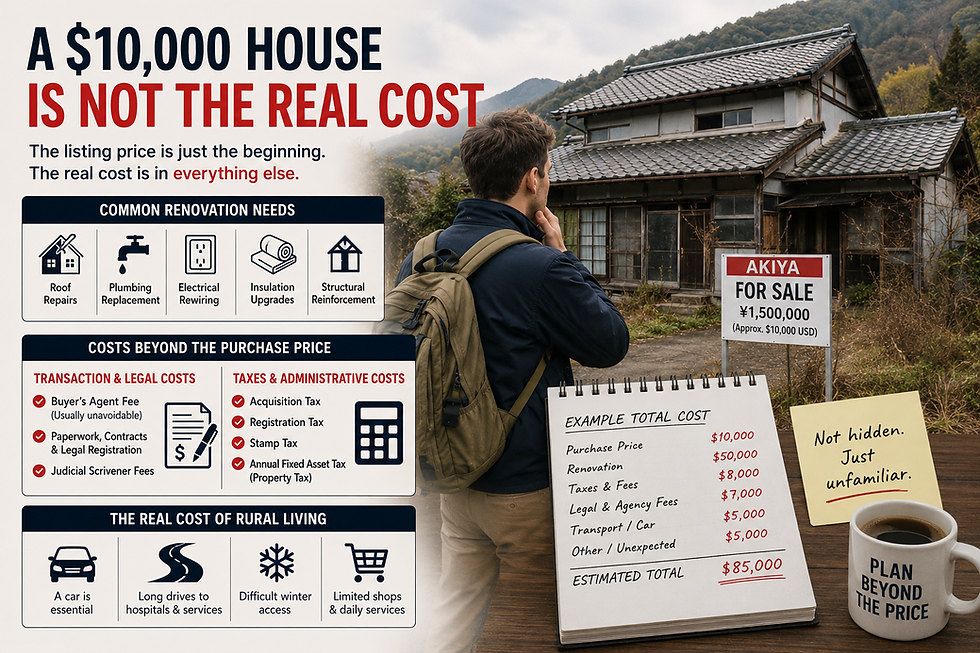
The appeal of a cheap rural house is obvious. The price is where the honesty in the listing usually ends. Many akiya carry condition problems that cost more to fix than the house cost to buy:
Outdated plumbing that needs full replacement
Roofs that leak or need replacing entirely
Mould damage from years of standing empty
Weak insulation that makes winters cold and summers hot
Clearing costs for belongings the previous owner left behind
Budget for the repairs before you fall for the price. The sticker number is the smallest part of what an akiya costs.
Why Japanese houses lose value
Unlike most Western markets, where buildings hold or gain value, Japanese homes depreciate fast. The structure loses value over time; only the land tends to hold or appreciate. A 30-year-old house may be worth almost nothing on paper even when the land under it is valuable. This pattern is a large part of why Japan has millions of vacant homes in the first place.
For anyone thinking of an akiya as an appreciating investment, this matters. The realistic expectation is that you're buying land plus a structure you'll need to maintain or rebuild, not an asset that climbs in value the way property does elsewhere.
Doing due diligence from overseas
This is where buying an akiya gets real. From abroad you can verify a surprising amount: the registered title and ownership, the land boundaries, zoning and building restrictions, fixed-asset tax records, and whether the structure predates current earthquake codes. What you can't judge from photos is condition — damp, rot, foundation movement, roof and termite damage, and the true cost of clearing the house out.
For anything you can't verify remotely, you need eyes on the property: a paid local inspector, a trusted contact, or a visit timed before you commit. Skipping this is how buyers end up with the house that cost more to fix than to buy.
Location and daily life in rural Japan
A cheap akiya is often cheap partly because of where it is. Before you buy, look hard at the location:
Distance from hospitals and emergency services
Whether you can manage without a car, which in most rural areas you can't
Whether the town is shrinking, with a declining population and thinning local infrastructure
Rural ownership also comes with social obligations that don't appear in the listing. Smaller neighborhoods notice newcomers and notice how a property is kept. Expect regular contact with neighbors and local officials, expectations to maintain the house and its surroundings, and in many areas a neighborhood association with its own duties and dues. None of this is a dealbreaker, but it's real, and it works better when you go in expecting it.
Practical tips before you buy
Budget for repairs and renovation well beyond the purchase price.
Inspect the property carefully, in person or through someone you trust on the ground.
Research the area for medical access, transport, and how the local population is trending.
Understand the paperwork and the 2026 filing requirements before you reach closing.
Expect to deal with the seller's agent in Japanese. You can manage this yourself with translation and preparation rather than handing the whole process to a paid concierge service.
Be clear on your own plan — a home you'll use, or a property you're holding — because it changes which trade-offs are worth making.
What to do next
If you're still working out whether an akiya is right for you, start with what an akiya actually is and why these houses sell so cheaply. From there, look at the real cost of buying one beyond the sticker price, and whether you should buy without visiting first. When you're ready to move from reading to doing, the Akiya Guide walks the full process step by step.


Comments