.png)
The ongoing costs of owning an akiya in Japan

What you keep paying after the purchase closes, plus the 2023 and 2026 rule changes that can raise the bill
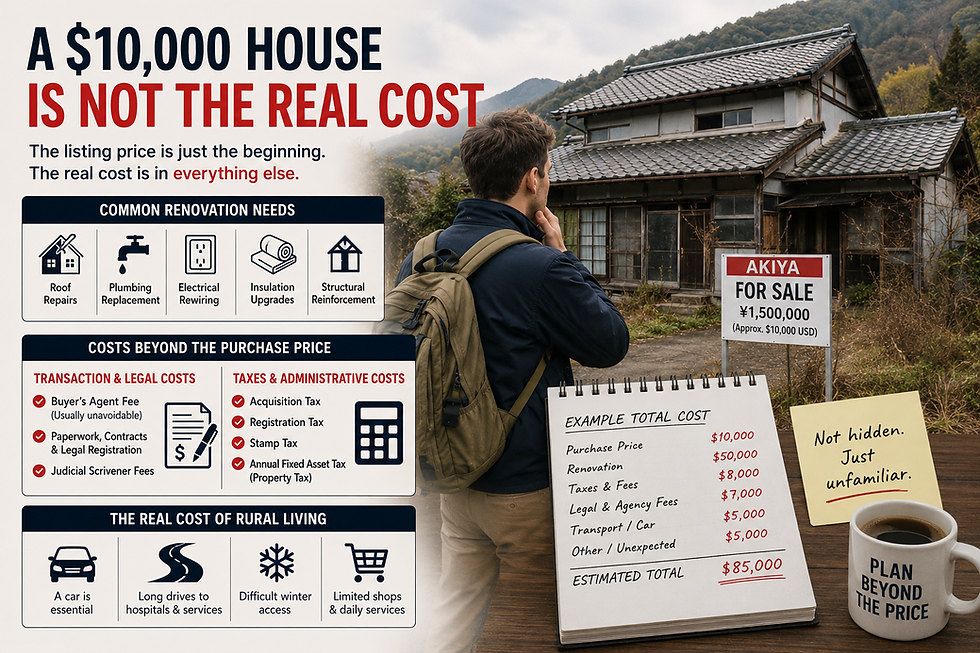
The purchase price is usually the smallest number in an akiya transaction. A house listed at one million yen, or at zero, still carries annual taxes, registration costs, and a maintenance obligation that does not pause when you fly home. The cost of owning an akiya covers the items that begin the day you take ownership, and two recent rule changes that can increase them.
Fixed asset tax and city planning tax
Every property owner in Japan pays kotei shisan zei, the annual fixed asset tax, levied by the municipality. The standard rate is 1.4 percent of the assessed value, which is set by the local government and is typically well below the market price. Many municipalities add toshi keikaku zei, a city planning tax of up to 0.3 percent, on land inside designated urban planning zones.
Residential land gets a reduction. For the first 200 square meters, the taxable base for the land is cut to one sixth. Land above that area is cut to one third. This reduction is why a small akiya on a modest lot can carry land tax of only tens of thousands of yen per year. It is also the reduction you can lose, which is the subject of the next section.
How the 2023 law can multiply your land tax
The reduction above applies only while a habitable house stands on the land and the property is maintained. The Act on Special Measures Concerning Vacant Houses, amended in 2023, gives municipalities the authority to remove it.
The original 2014 law let a municipality designate a dangerous or unsanitary property as a specified vacant house and, after a formal recommendation, strip the residential land reduction. The December 2023 amendment added an earlier category, the management-deficient vacant house (kanri fuzen akiya), for properties at risk of reaching that state. A property that receives a recommendation under either category loses the one-sixth reduction. In practical terms, the land portion of your fixed asset tax can rise to roughly six times what you were paying. The Library of Congress summary of the amendment sets out the mechanism.
An absentee owner is exposed to this. Overgrown vegetation, a failing roof, or accumulated mail can trigger municipal guidance, and a foreign owner living abroad is harder for the local office to reach. The reduction protects you only while the property looks maintained.
The recurring cost of being an absentee owner
If you do not live in Japan, several line items apply that a resident owner avoids or absorbs.
A tax representative, nozei kanrinin, is required to receive and pay municipal tax notices on your behalf. This is a person or a firm in Japan, and a firm charges a fee.
A property management or monitoring service keeps the house from sliding into the management-deficient category described above. Monthly or seasonal visits, ventilation, and basic upkeep run from a few thousand yen per visit upward, depending on distance and scope.
Building and contents insurance, utility standing charges if you keep services connected, and your own travel to inspect the property are the remaining recurring items. None is large on its own. Together they set a floor under what the house costs you each year before any repair.
New compliance costs in 2026
Two 2026 changes add paperwork, and in some cases professional fees, to ownership.
First, the Foreign Exchange and Foreign Trade Act. As of April 2026, the exemption that previously covered acquisition of real estate for personal residential use was removed. Non-resident buyers now file an acquisition report, generally within 20 days of the transaction, through the Bank of Japan to the Ministry of Finance. If you are buying from abroad, budget for the filing and, in most cases, for help preparing it.
Second, nationality disclosure on registration. During fiscal 2026 Japan is implementing a requirement that property owners state their nationality on the registration application and attach supporting documentation, such as a passport copy, at the point of ownership transfer. The information is held in a government database and does not appear on the public registry certificate. The Japan Times reported the change here. The practical effect for buyers is more documentation at closing and, during early rollout, possibly longer registration times.
Renovation is a cost that recurs
Renovation is often treated as a one-time number, but the components age on their own schedules. A roof, a water heater, plumbing, and structural timber each have a service life, and an akiya that sat empty has usually spent part of that life already. Even after the initial work, plan for the next item to come due within a few years rather than a few decades.
The cost of owning an akiya: what to budget
Before viewing a single listing, build the annual figure: fixed asset tax and city planning tax, tax representative fee, management or monitoring service, insurance, utility standing charges, and an allowance for repairs. For a modest rural akiya kept in maintained condition, owners commonly see an annual carrying cost in the low hundreds of thousands of yen, before any major renovation and before the tax penalty that follows a management recommendation.
You can estimate the purchase side, including registration and the agent fee rules, with the Hello Akiya cost calculator. The Due Diligence Kit covers what to check before you commit, and the Akiya Guide walks the full purchase and ownership process. If you are still deciding whether buying makes sense at all, start with the free decision tool.


Comments