.png)
How Japanese Real Estate Agents Work (and What the Fees Are)

Once you're past "is this real" and into "how do I actually buy," the next question is who's on your side and what they cost. Japanese real estate agent fees are set within legal limits, the agent's role is narrower than many foreign buyers expect, and understanding both early saves you from assumptions imported from your home country that simply don't hold here. I came to this through studying for a California license, where I learned a fiduciary, buyer's-agent framework — and one of the first things I had to unlearn was assuming Japan works the same way.
The agent's role isn't what you might assume
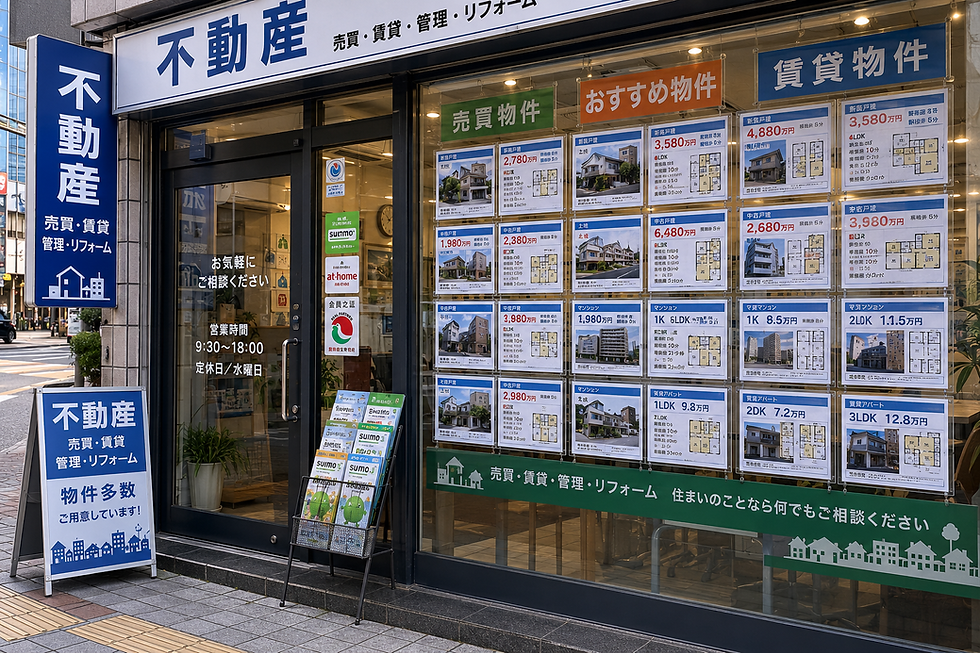
In much of the US, a buyer often has their own agent representing their interests, paid out of the deal. In Japan, it's common for a single agent (the 仲介, chūkai, intermediary) to handle the transaction between buyer and seller. They're facilitating a deal more than championing one side. That's not sinister — it's just a different structure — but it means you shouldn't assume the friendly agent showing you the house is your advocate the way a buyer's agent would be back home. They're moving the transaction forward. Your due diligence is still yours to do.
The agent's genuinely valuable, legally required job comes near the end: the important matters explanation (重要事項説明書, jūyō jikō setsumeisho), a detailed disclosure document a licensed agent must walk you through before you sign. It covers the legal and physical realities of the property — zoning, rebuild rights, infrastructure, encumbrances. It's dense, it's in Japanese, and it's one of the most important documents you'll encounter. Rushing it is a mistake.
How Japanese real estate agent fees are calculated
The commission is capped by law, which is genuinely buyer-friendly. For a standard transaction, the legal maximum brokerage fee is 3% of the price plus ¥60,000, plus consumption tax. So on a ¥10M house, the cap works out to a few hundred thousand yen — predictable and bounded, not an open-ended negotiation.
Cheap akiya create an awkward wrinkle, though. On a ¥2M house, 3% is only ¥60,000 — barely worth an agent's time given the same paperwork and legwork a pricier deal requires. To keep agents willing to handle low-value rural properties at all, Japan allows a higher relative commission cap on inexpensive properties. The exact figures have been adjusted in recent years, so I won't quote a number that might be stale by the time you read this — but the principle is what matters: on a very cheap house, expect the commission to feel large relative to the price, because the work doesn't shrink just because the house is cheap. That's normal and legal, not someone fleecing you.
Where this leaves a foreign buyer
A few honest implications. Don't expect the agent to protect you from a bad purchase — that's not their structural role, and the disclosure document, however thorough, is not the same as advocacy. Budget for the commission as a real closing cost, and don't be alarmed when it's proportionally high on a cheap house. And take the important matters explanation seriously enough to have it properly understood — not skimmed through machine translation while everyone waits for you to sign.
That last point is where a lot of distance-buyers struggle, and it's adjacent to why my Listing Decoding Service exists — at $149 per property, I personally research and decode a Japanese listing beyond the photos and machine translation, so you understand what you're actually looking at before you're sitting across from an agent. It doesn't replace the agent or the disclosure document or a scrivener. It helps you walk in informed rather than dependent on the one person in the room who's paid when the deal closes.
The bottom line
The Japanese agent system is more regulated and more bounded than the free-for-all some buyers fear, and the capped fees are a real protection. But "regulated" isn't "looking out for you." The structure assumes a buyer who can read the documents and do their own homework — which is exactly the buyer worth becoming before you start viewing houses.
FAQ:
How much are real estate agent fees in Japan? Capped by law at 3% of the price plus ¥60,000 plus consumption tax for standard transactions. Cheap properties have a higher relative cap so agents will handle them.
Do I need my own buyer's agent in Japan? Not necessarily — a single intermediary agent often handles both sides. That means you can't assume the agent is your advocate; your due diligence is your own.
What is the important matters explanation? A legally required disclosure document (重要事項説明書) a licensed agent must explain before you sign, covering the property's legal and physical realities.
Are agent fees negotiable in Japan? The figure is a legal maximum, so there can be room below it, but on cheap akiya the commission is often already near the floor of what makes the work viable.


Comments