.png)
Living in Oita: what it's actually like before you buy a house here

Here's the everyday picture a weekend of hot springs won't give you: getting around, the weather, what housing looks like, and a few things worth checking before you buy.
Most people meet Oita over a weekend in Beppu or Yufuin and leave charmed by the baths. Living in Oita is a different question, and a fair one to ask before you buy. This is the day-to-day view from someone who does it: how you get around, what the weather does, what the housing actually looks like, and the handful of things worth checking before you commit. Some of it is genuinely nice. Some of it is just practical.
Getting in and out
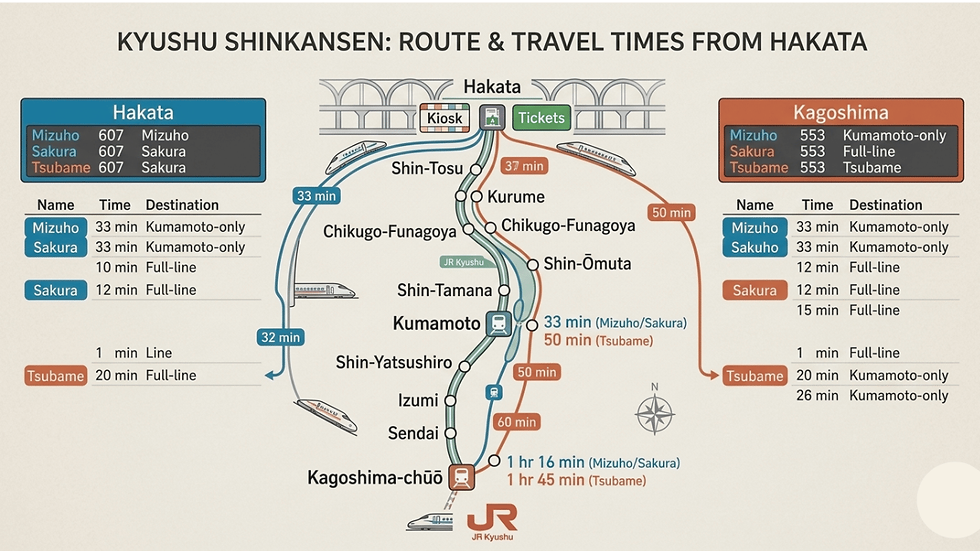
Oita sits in the northeast corner of Kyushu, on the Seto Inland Sea side rather than the open Pacific. One detail matters more than people expect: the Kyushu Shinkansen doesn't come here. The bullet train runs down the west side of the island, through Fukuoka, Kumamoto, and Kagoshima. We're on the east coast, so the quick way out by rail is the Sonic limited express to Kokura, about 80 minutes, where you pick up the Sanyo Shinkansen for Osaka and Tokyo.
Most of the time, though, you fly. Oita Airport is out on the Kunisaki Peninsula, with direct flights to Tokyo Haneda in about 95 minutes, plus Osaka and Nagoya. The airport bus reaches Oita City in around an hour and Beppu in about 45 minutes. There are also ferries across the Inland Sea to Shikoku from Usuki and Saiki, handy if you're looking at the southern coast.
So: the capital region and Fukuoka are easy to reach. Getting to Oita quickly by train from elsewhere in Japan is less so. If you travel a lot, plan around the airport rather than the station.
The weather you're signing up for
The coast is humid subtropical: mild winters that rarely hold snow at sea level, and hot, humid summers. Two stretches of the year are worth planning around. Tsuyu, the rainy season, runs from about early June into mid or late July, and typhoon season lands in late summer and autumn. Both bring heavy rain, which mainly matters if a house sits below a slope, beside a river, or near the shore.
Inland runs cooler. The Kuju highlands, Taketa, and the area around Hita sit at elevation and see snow most winters. Older houses up there were rarely built with insulation, so an unrenovated one can feel cold and damp in a way a modern or well-renovated house simply doesn't. That's less about Oita and more about which house you choose.
Onsen is just part of the day here
Oita pumps more hot spring water than any prefecture in Japan, and around Beppu it's woven into ordinary life rather than kept for tourists. Some houses and apartments have onsen water piped straight in, and public baths are cheap and everywhere. If you buy a place with an onsen supply, check what it costs to run and who maintains the source, since it isn't free and it's harder on pipes than tap water. Small thing, easy to overlook.
What living in Oita costs, and where people settle
Day-to-day costs run below Tokyo, Osaka, and Fukuoka, though where you settle shapes the experience more than any prefecture average does.
Oita City, the capital, has around 475,000 people and the full set of services: hospitals, a port, trains, a working downtown. Beppu is the second hub and unusual for its size, because Ritsumeikan Asia Pacific University brings a sizable international population, which means more English-friendly services and neighbors used to foreigners. Nakatsu in the north is industrial, with a Daihatsu plant nearby. Hita is a river town inland. Usa, Saiki, and Bungo-ono are more rural. Yufu contains Yufuin.
If you'd rather be near an international community that already exists, Beppu is the natural place to start looking.
The houses run from move-in-ready to full projects
Worth clearing up early, since the cheap old vacant houses get most of the attention online: Oita's housing is not only rundown kominka waiting for a gut renovation. In and around the cities you'll find modern, move-in-ready detached houses, newer builds, tidily renovated homes, and mansion units (the Japanese word for condo apartments). Prices track condition and location, as you'd expect.
The countryside vacant house is a genuine option too, just a different one. It usually trades a low price and more space for a car-dependent spot, some distance from a hospital, and a house that may need work. You also join the local jichikai, the neighborhood association that looks after shared roads, waste points, and upkeep. Plenty of people are glad they did. The point is that you're choosing along a range, not picking the only thing on the shelf.
A few practical things to plan for
None of these are dealbreakers, but they come up for foreigners living outside the city centers. Most places really do need a car. Away from Beppu, daily life runs mostly in Japanese, from the clinic desk to the association meeting. An older house needs ongoing upkeep, the way older houses do anywhere. And since parts of the coast carry flood, landslide, or tsunami exposure and the Kuju range is volcanic, it's worth pulling up the national hazard maps for any specific address. That one takes five minutes and settles a lot of questions.
Know enough to ask the right questions
Whether a house in Oita is a good buy rarely comes down to the asking price. It comes down to what you know to ask before you sign: how you'll reach the airport, how the place handles a June downpour, what any onsen line costs to run, whether the address sits in a hazard zone, what the neighborhood association expects. Buyers who ask those early tend to end up happy with what they chose.
If you want a structured way to work through it, the free decision tool and the property viewing checklist at helloakiya.com are made for exactly this stage, before you buy.
Next in the series: Miyazaki


Comments